
September 13, 2026
0 comments


Table of Contents
- What Is a Contour Wedding Band?
- Straight vs Curved Wedding Bands: Key Differences
- How to Choose the Right Wedding Band for Your Engagement Ring
- The Custom Wedding Band Design Process
- Understanding the Engagement Ring and Wedding Band Gap
- Wedding Band Styling Tips
- Conclusion
- Frequently Asked Questions
Last Updated: September 12, 2026
What Is a Contour Wedding Band?
A contour wedding band is a wedding ring shaped to curve around the profile of an engagement ring, so the two sit together without a gap. This guide from Starfire Jewellery explains when that curve is worth it, and when a straight band does the job just as well.
The choice matters more than most couples expect. An engagement ring setting sits proud of the finger, and a straight band pushed against it leaves a visible opening. A contour wedding band, sometimes called a curved or shaped band, is cut to wrap that setting so the pair reads as one continuous piece of jewellery.
The trade-off is simple: a contour band fits beautifully against one specific ring, while a straight band fits against almost anything, including a future upgrade or a ring worn on its own.
Gemological Institute of America guide to ring settings
Straight vs Curved Wedding Bands: Key Differences
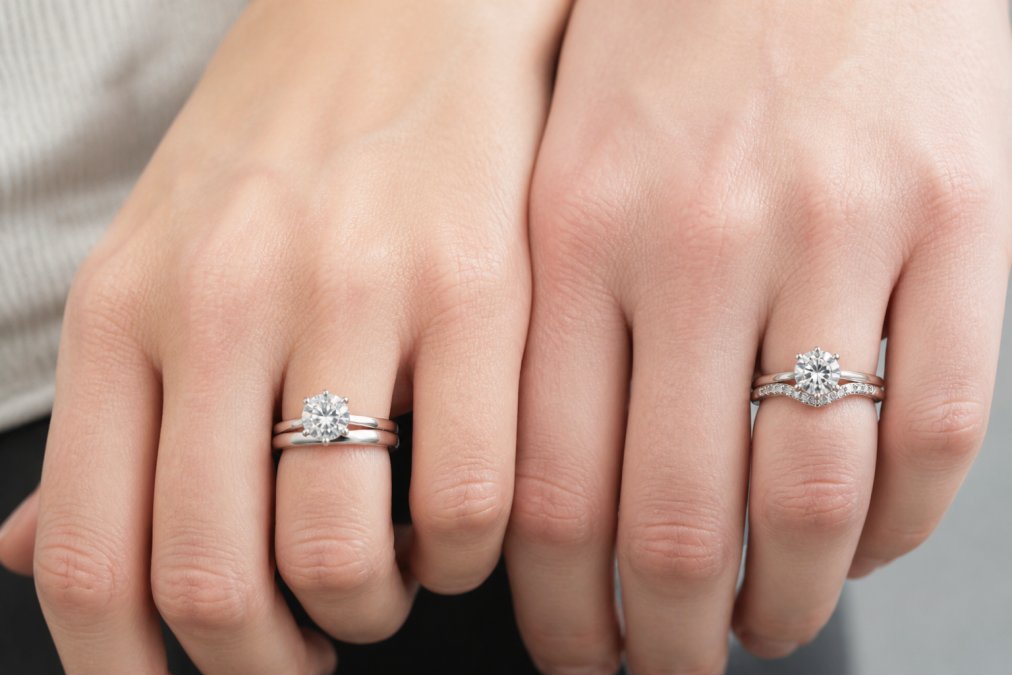
The core difference comes down to fit and silhouette. A straight band is a uniform circle; a curved band is shaped to follow the contours of your engagement ring. Neither is better in absolute terms. They solve different problems.
Fit and Gap
The gap between rings is the whole reason contour bands exist. If your engagement ring has a raised setting, a straight band will leave a wedge of skin visible between the two. A contoured band closes that space.
How much gap you get depends on the engagement ring setting. A low-profile setting or bezel setting sits close to the finger, so a straight band often sits almost flush. A cathedral setting or halo setting lifts the centre stone higher, which opens a wider gap.
Style and Silhouette
A straight band keeps a clean, classic ring silhouette. A curved band follows the shape of the engagement ring, which can look more deliberate and matched. A V-shaped band suits a pear or marquise centre stone, while a gentle curve suits a round or oval solitaire.
| Feature | Straight Band | Contour Wedding Band |
|---|---|---|
| Fit against engagement ring | Leaves a gap with raised settings | Sits flush against the setting |
| Best for | Low-profile settings, standalone wear | High-set rings, halo and cathedral settings |
| Versatility | Wears well alone or stacked | Shaped for one specific ring |
| Resizing | Straightforward | Harder once the curve is cut |
| Future-proofing | Easy to pair with a new ring | Tied to the original engagement ring |
How to Choose the Right Wedding Band for Your Engagement Ring
Start with the profile height of your engagement ring. That single measurement decides whether you need a contoured band at all. Profile height is the distance from the top of the finger to the highest point of the setting. As a working rule, a setting under about 4 mm usually lets a straight band sit close enough that any gap is barely visible (gia.edu). Between roughly 4 mm and 6 mm, the gap becomes noticeable and a shallow contour or a notched band is often enough. Above about 6 mm, common with cathedral, halo and high-set solitaire designs, a straight band leaves an obvious wedge, and a full contour is usually the cleanest answer.
Work through these steps:
- Measure the profile height: how far the setting rises above the finger, taken at the point where the band would sit.
- Identify the setting type and stone shape (prong, bezel, halo, cathedral, tension; round, oval, pear, marquise, emerald).
- Decide whether you want a gapless look or are happy to accept a small gap.
- Try a straight band against the ring first, before assuming you need a curve.
- If the gap bothers you, ask about a custom contour, a notched band, or an open band.
Match the band shape to your setting
Use this diagnostic to narrow the field before you visit a jeweller.
| Your engagement ring | Likely band shape | Why |
|---|---|---|
| Low-profile solitaire or bezel set | Straight band | Setting sits close to the finger; gap is minimal |
| High-set round or oval solitaire | Gentle contour or shallow curve | Follows the basket without a sharp V |
| Halo setting | Contour with a wider sweep | The halo adds width as well as height |
| Cathedral setting | Contour or notched band | The raised shoulders create a deep gap |
| Pear or marquise centre stone | V-shaped or chevron band | The point of the stone needs clearance |
| Emerald or radiant cut | Straight or slight curve | Straight edges sit neatly against a straight band |
| Three-stone or cluster | Custom contour | The side stones dictate an irregular profile |
A notched band cuts a small recess for the setting to sit into. An open band leaves a gap in the metal itself. Both suit intricate settings where a full contour is overkill, and both are usually cheaper than a bespoke contour because less metal is shaped.
The future-proofing question
Most guides stop at fit. The harder question is what happens in five or ten years. A contoured band is shaped to one specific engagement ring. If you later upgrade the engagement ring, inherit a different one, or want to wear the band on its own, the curve can look odd or sit uncomfortably. A straight band pairs with almost anything, which is why it holds its usefulness, and often its resale appeal, better over time. If you are undecided, a shallow contour is a reasonable middle ground: it closes most of the gap while still reading as a near-straight band when worn alone.
Pro Tip
Bring your engagement ring to the fitting. A contour band shaped from a photo rarely matches as well as one shaped against the actual ring, because the curve has to clear the setting at the exact point where the two rings meet.
The Custom Wedding Band Design Process
At Starfire Jewellery, the process starts with a consultation where the ring is measured and the curve is mapped to the setting. You see the design before anything is cast, so you can adjust the profile height, band width, and metal before committing.
At Starfire Jewellery, the process starts with a consultation where the ring is measured and the curve is mapped to the setting. You see the design before anything is cast, so you can adjust the profile height, band width, and metal before committing.
Expect to decide on precious metals, band width, and finish at this stage. A comfort fit inner profile is worth asking about if you wear the ring daily.
What custom contouring actually costs
A bespoke contour carries a premium over a standard straight band because of the extra design time, the CAD work, and the hand-finishing needed to match the curve to your ring. Pricing depends on the complexity of the contour, the metal chosen, and whether you are matching an existing band or starting fresh. Ask for the quote to be broken into design, metal, and finishing so you can see where the money goes.
Metal compatibility and wear patterns
This is the part most guides skip. When two rings sit flush against each other, their surfaces rub every time your hand moves. If both rings are the same metal, platinum against platinum, or 18ct yellow gold against 18ct yellow gold, the wear is usually even and slow. Mix metals and the softer one loses. Platinum is denser and harder-wearing than gold, so a platinum engagement ring rubbing against a gold band will gradually wear the gold. Within gold, 18ct is harder than 9ct, and rose and yellow gold behave similarly to each other but differently from white gold, which is usually rhodium-plated and can show the rub sooner as the plating thins.
A contour band concentrates that friction at the curve, where the two rings touch over a smaller area. That can accelerate wear at the contact point compared with a straight band, which touches along a broader surface. The practical fixes are simple: match metals where you can, choose a slightly harder alloy for the band if you cannot, and have both rings checked and polished periodically. A jeweller can also add a tiny clearance in the contour so the rings touch at the shank rather than at the setting.
Resale and long-term flexibility
A custom-contoured band is made for one ring. That is its strength and its limitation. If you ever want to wear the band alone, pair it with a different engagement ring, or pass it on, the curve may not sit well against anything else. A straight band keeps that flexibility, which is why it tends to hold broader appeal if it is ever sold or handed down. If future-proofing matters to you, weigh the gapless look you get now against the options you give up later, and consider a shallow contour or a notched band as a compromise that closes most of the gap without locking the shape to a single ring.
Watch Out
Soldering rings together means they can no longer be worn separately and makes future resizing more complex. Decide this one carefully before committing.
Guide to precious metal properties and wear
Understanding the Engagement Ring and Wedding Band Gap
The engagement ring and wedding band gap is the space between the two rings when worn together. It is caused by the height and width of the engagement ring's setting, not by the band being the wrong size.
Some couples accept the gap. Others find it catches on clothing or simply looks unfinished. If the gap bothers you, soldering the two rings together is one option, though it locks the pair into a single unit and makes wearing the engagement ring alone impossible.
Another option is a spacer band, a thin plain ring worn between the two. It is a practical fix, but it adds a third ring to the stack.
Watch Out
Soldering rings together means they can no longer be worn separately and makes future resizing more complex. Decide this one carefully before committing.
Wedding Band Styling Tips
Wedding band styling tips come down to balance. If the engagement ring is detailed, keep the band simple. If the engagement ring is a plain solitaire, the band can carry more detail.
- Match metal across both rings for a seamless gapless look.
- Keep the band width close to the engagement ring's shank width.
- For stacking, vary texture rather than adding more stones.
- A tapered shank on the engagement ring can reduce the gap without a contour.
- Consider a bridal set designed together from the start.
Jewellery maintenance matters here too. Contoured bands collect more debris in the curve, so a soft brush and warm water clean every few weeks keeps the detail sharp.
Conclusion
Choosing between a contour wedding band and a straight band comes down to your engagement ring setting and how you want the pair to read. A contour band closes the gap; a straight band keeps your options open.
At Starfire Jewellery, we design custom contour bands shaped to your actual engagement ring, with a personalised consultation and CAD preview before anything is cast. Our team sources beyond conflict-free diamonds, offers a price match guarantee, and stays with you for aftercare long after the purchase.
Book a consultation with Starfire Jewellery and have your wedding band shaped to fit your ring exactly.
Frequently Asked Questions
How do I know if I need a contour wedding band?
You likely need a contour wedding band if your engagement ring has a raised setting, such as a cathedral or halo style, or a large centre stone that prevents a straight band from sitting flush. Test by placing a straight band next to your ring; if you see a gap or the band rocks, a contour band will bridge that space. A jeweller can assess your ring's profile height and recommend a custom curve.
Can a straight wedding band be worn with a low-set engagement ring?
Yes, a straight wedding band can work with a low-set engagement ring if the ring's profile is low enough that the band doesn't collide with the setting. However, if the engagement ring has a high profile or protruding stones, a straight band may leave a gap or cause wear. In those cases, a contour band or a notched band provides a better fit.
What are the pros and cons of contour wedding bands?
Contour bands offer a flush fit and create a seamless look with your engagement ring. On the downside, they are custom-made and may not stack well with other straight bands. Weigh these factors against your priority for fit and aesthetics.
How does a custom-designed wedding band ensure a perfect fit?
A custom-designed wedding band is measured and shaped to match your engagement ring's exact contours, including the setting height, stone shape, and band width. The jeweller uses a CAD model to test the fit before casting. This process eliminates gaps and ensures the band sits comfortably without rubbing. It also allows you to choose metal and finish.
Related post
Contour Wedding Band vs Straight Band Guide (2026)

Jewellery Store Near Me: Finding the Right One

The value of Lab Diamonds Vs Natural Diamonds

Why Jewellery Maintenance Matters (and How to Care for Your Pieces Properly)

Gold Prices in Australia: Turn Your Old Gold into Something New
