
September 13, 2026
0 comments


Table of Contents
- How to Choose a Jewellery Store Near Me
- Custom Engagement Rings: The Bespoke Design Process
- Beyond Conflict-Free Diamonds: What Ethical Sourcing Really Means
- How to Choose an Engagement Ring: A First-Timer's Guide
- Fine Jewellery Collections: Gold, Silver, and Gemstones
- Jewellery Repairs, Valuation, and Aftercare
- Visiting the Store: What to Expect
- Frequently Asked Questions
Last Updated: September 12, 2026
How to Choose a Jewellery Store Near Me
Finding a jewellery store near me that I can genuinely trust starts with asking better questions than the showroom floor encourages. At Starfire Jewellery, we believe the right store is the one that explains its sourcing, its craftsmanship, and its aftercare before you ever talk about budget. This guide walks you through the whole decision, from the first consultation to the day you collect the finished piece.
Most buyers start with a search for a jewellery store near me and end up comparing storefronts on price alone. That is the first mistake. A ring is not a commodity; it is a piece you will wear every day for decades, and the store's process matters as much as the stones in the case.
Key Takeaway
The store that answers your questions clearly, in writing, before you commit is almost always the better long-term choice, even if another quote looks lower on paper.
Questions to Ask Before You Commit
A good jeweller will welcome these questions. A poor one will deflect them.
- Can you show me certification for every diamond you source?
- What happens if the stone comes loose within the first year?
- How many design revisions are included, and what triggers an extra charge?
- Do you offer a written valuation for insurance purposes?
- What is your price match guarantee, and what does it exclude?
Ask about the design process itself, not just the finished product. A store that cannot explain how it moves from sketch to CAD to casting is a store that is reselling rather than making.
Custom Engagement Rings: The Bespoke Design Process
Custom engagement rings are built in stages, and the best designers walk you through each one rather than disappearing with your brief. The process typically moves from consultation to concept sketches, then to a CAD render you approve, then to casting, stone setting, and final polish. Nothing should be cast until you have signed off on the design.
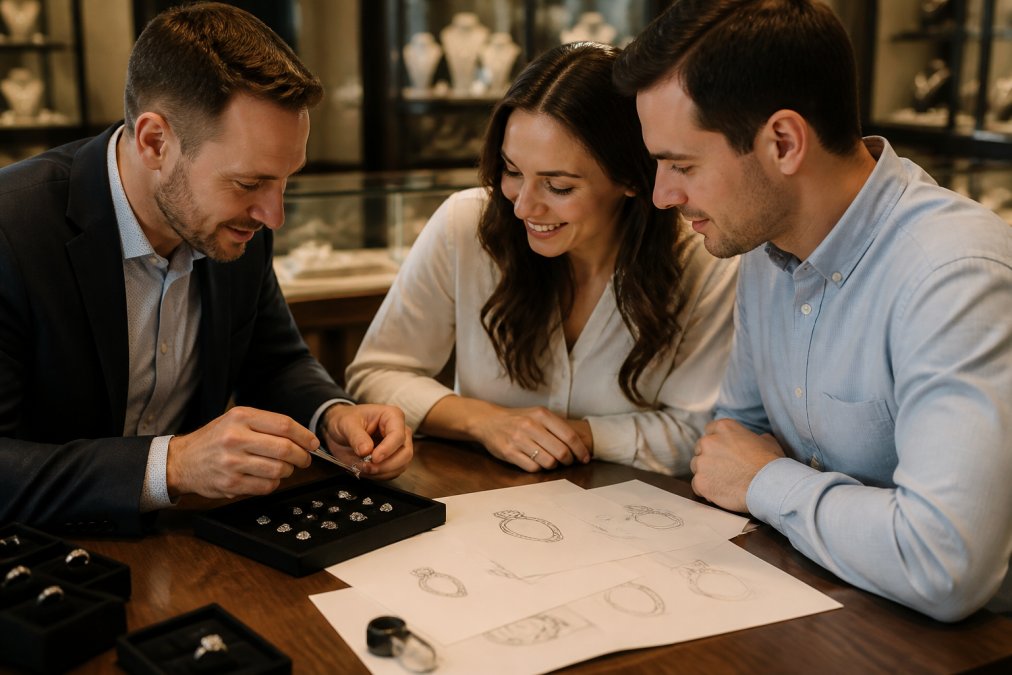
From Consultation to Finished Ring
The consultation is where a bespoke piece is won or lost. Bring inspiration images, an idea of the wearer's style, and an honest budget range. A skilled designer will translate that into two or three directions rather than overwhelming you with options.
Starfire Jewellery founder Shweta Khan has more than 25 years in the diamond trade, and that background shapes how we run consultations: we explain what each choice means for appearance and durability, not just in dollars. Ask any designer how many revisions are included before you start. Getting that in writing prevents the surprise-charge problem that frustrates so many first-time buyers.
Beyond Conflict-Free Diamonds: What Ethical Sourcing Really Means
"Conflict-free" is the floor, not the ceiling. A diamond can be conflict-free and still be cut in a workshop with poor labour standards, or traded through a chain with no traceability. Beyond conflict-free diamonds means you can trace a stone from mine to setting and know the people in that chain were treated fairly.
Ask for the certification that travels with the stone and check that the paperwork matches the stone you are shown. Reputable suppliers will let you verify the certificate number independently. This is where a jeweller with wholesale connections has an advantage: direct sourcing means a shorter chain and fewer places for provenance to get lost.
How to Choose an Engagement Ring: A First-Timer's Guide
Choosing an engagement ring comes down to four things: the wearer's taste, the stone, the metal, and the budget you can hold without regret. Get the first one right and the rest becomes a series of manageable decisions rather than an intimidating exam.
Understanding the 4Cs Without the Jargon
The 4Cs are cut, colour, clarity, and carat weight. Cut is the one to prioritise, because it controls how much light the stone throws back. A well-cut smaller diamond will out-sparkle a poorly cut larger one every time (gia.edu).
| The 4C | What It Controls | Where to Compromise |
|---|---|---|
| Cut | Brilliance and sparkle | Rarely worth compromising |
| Colour | Warmth or whiteness | Slight warmth is hard to see |
| Clarity | Internal flaws | Eye-clean is enough |
| Carat | Physical size | Adjust to fit budget |
For metal, 18kt gold and platinum are the durable standards for everyday wear. Ask to see the stone under different lighting before you decide; showroom spotlights flatter everything.
Fine Jewellery Collections: Gold, Silver, and Gemstones
Fine jewellery covers a wider field than engagement rings, and a good store carries pieces across precious metals and gemstone settings. Look for tennis bracelets, necklaces and pendants, bangles and bracelets, and diamond and gemstone rings set in 18kt gold. A store worth your loyalty will have both timeless classics and pieces that follow the latest trends, rather than one or the other.
Starfire Jewellery keeps a collection in store and online, so you can browse the online collection first and then see pieces in person. When you are comparing, ask whether the piece is handcrafted or mass-produced, and whether the gemstone settings are prong or bezel. Bezel settings suit daily wear because they protect the stone edges; prong settings show more of the stone but need more checking.
Jewellery Repairs, Valuation, and Aftercare
Jewellery repairs and valuation services are the test of whether a store sees you as a customer or a client. A jeweller who handles your repairs, professional cleaning, and re-polishing is one you can return to for decades. Ask up front whether they do this work in-house or send it away, and how long a standard repair takes.
What Actually Happens to a Repaired Piece
Most repairs follow a predictable sequence, and knowing it helps you judge a quote. A ring resizing usually means cutting the band, adjusting it, re-soldering, then re-polishing and re-checking any stones near the join (gem.org.au). A loose stone is tightened by re-tipping or rebuilding the prongs, not simply pushed back into place. A snapped chain is soldered and then polished so the join is invisible. Re-plating white gold with rhodium is a separate service again, because white gold naturally dulls as the plating wears.
Ask for the expected timeframe in writing when you leave the piece, and ask whether the quote is fixed or an estimate. A store that will not commit to either is one to think twice about.
How a Valuation Works and Why Insurers Ask for One
An insurance valuation is not the same as a receipt. A receipt shows what you paid; a valuation describes the piece in enough detail that it could be replaced, metal type and purity, stone dimensions and quality grades, setting style, and an assessed replacement value. Insurers typically want this because it lets them settle a claim without arguing about what the item was.
A few practical points most buyers only learn after a loss:
- Get the valuation done at the time of purchase, not months later, while the details are fresh and documented.
- Keep the valuation, the certificate, and the receipt together, and store a digital copy somewhere separate from the jewellery itself.
- Have pieces revalued periodically. Metal and gemstone markets move, and an outdated figure can leave you underinsured.
- Tell your insurer if a piece is worn daily or kept in a safe, because some policies price those differently.
If a store cannot arrange a valuation or point you to an independent valuer, that is useful information about how far its aftercare actually extends.
Pro Tip
Photograph every piece you buy alongside its certificate and valuation on the day of purchase. If you ever need to claim, that single photo set saves weeks of back-and-forth with your insurer.
Cleaning and Storage You Can Do Yourself
Aftercare is not only what the store does for you. Most everyday pieces can be kept bright with warm water, a drop of mild dish soap, and a soft brush, followed by a rinse and a pat dry with a lint-free cloth. Skip this for opals, pearls, emeralds and other porous or soft stones, which are better cleaned with a dry soft cloth only (gia.edu). Store pieces separately in soft pouches or a lined box so harder stones do not scratch softer ones, and take chains off before showering or swimming to avoid tangles and chlorine damage. A professional clean and inspection once or twice a year catches loose prongs before a stone is lost.
Visiting the Store: What to Expect
A first visit should feel like a conversation, not a sales pitch. Expect to be asked about the occasion, the wearer's style, and your budget range, and expect to see stones in person rather than only on a screen. Appointment booking is worth using for custom work, because it gives you undivided attention instead of a rushed counter conversation.
How to Prepare So the Visit Is Worth the Trip
Walking in cold is the main reason first visits feel rushed. A little preparation changes the whole conversation:
- Bring inspiration images, even rough ones. A designer can read more from three saved photos than from a vague description.
- Know the wearer's ring size if you can, or bring a ring that fits them.
- Have an honest budget range in mind, not a single number. It lets the jeweller show you options that actually fit rather than guessing.
- Bring any existing pieces you want matched, resized, or valued, so the visit covers everything at once.
- Note the store's trading hours before you go, and check whether weekend or evening appointments are available if weekdays are difficult.
What to Look For While You Are There
Use the visit to compare stores on substance, not just stock. A few things worth checking:
- Ask to see the same style of stone under different lighting, showroom spotlights flatter everything, so ask for a look near a window or under a daylight lamp.
- Ask whether pieces are handcrafted on site or bought in, and whether custom work is done in-house or outsourced.
- Ask what aftercare is included: free cleaning, annual inspections, warranty on settings, and how long it lasts.
- Ask how long a custom piece takes from approved design to collection, and whether that timeline is guaranteed.
- If you are comparing quotes, ask each store to itemise metal, stone, and labour separately so you are comparing like with like.
Booking, Collecting, and Following Up
Appointment booking is not just a courtesy; for custom work it is close to essential, because design consultations need uninterrupted time. If a store offers online booking or click-and-collect, use it to reserve a viewing slot and confirm the piece is in stock before you travel. When you collect a finished piece, ask for the certificate, the valuation, and any warranty terms in writing on the day, and confirm who to contact if something needs adjusting later.
Bring your questions, take notes, and do not feel pressured to decide on the day. A confident jeweller knows a considered buyer comes back. If a store cannot tell you its trading hours, its aftercare terms, and who will handle your repair, that tells you something about how it will treat you after the sale.
Frequently Asked Questions
What should I look for when choosing a local jewellery store?
Look for transparent sourcing, in-house craftsmanship, and a clear aftercare policy. Ask whether the jeweller can source certified diamonds and gemstones, how they handle repairs, and whether they offer a price match guarantee. A store that invites you to ask questions and explains its process is more likely to earn your trust than one that rushes a sale. Starfire Jewellery, for example, offers a personalised design journey and a price match guarantee.
How do I know if a jewellery store uses ethically sourced diamonds?
Ask for certification and supply chain details. Beyond conflict-free diamonds means the stones are traceable and sourced responsibly, not just compliant with minimum standards. A reputable jeweller will explain where stones come from and provide documentation. Starfire Jewellery specialises in beyond conflict-free diamonds and can verify sourcing before you commit, so you know exactly what you are buying.
What are the benefits of custom engagement rings over ready-made pieces?
Custom engagement rings let you choose the stone, setting, and metal to match your partner's style and your budget. You also get a one-of-a-kind piece with a design story. The process usually involves a consultation, design revisions, and a final fitting. Starfire Jewellery guides you through each step, from selecting a certified diamond to approving the finished design, so you are never left guessing.
How can I verify the quality of gold and gemstones before purchasing?
Check for hallmarks on gold and ask for gemstone certification from a recognised laboratory. A jeweller should show you the stone under magnification and explain its cut, colour, clarity, and carat weight. For pre-owned or antique jewellery, request a valuation. Starfire Jewellery offers valuation services and can walk you through the specifications so you feel confident in your purchase.
Choosing a jeweller is really a decision about who you want standing behind your most important pieces for the next twenty years. Starfire Jewellery offers custom design, beyond conflict-free diamond sourcing, in-house aftercare, and a price match guarantee, all backed by a founder with over 25 years in the diamond trade. Book a consultation with Starfire Jewellery and start designing a piece you will still be proud of decades from now.
Related post

Contour Wedding Band vs Straight Band Guide (2026)
Jewellery Store Near Me: Finding the Right One

The value of Lab Diamonds Vs Natural Diamonds

Why Jewellery Maintenance Matters (and How to Care for Your Pieces Properly)

Gold Prices in Australia: Turn Your Old Gold into Something New
