
November 11, 2026
0 comments


Last Updated: November 9, 2026
Quick Summary
To measure ring finger for a wedding band, wrap string or a paper strip around the base of the finger, mark the overlap, and read the length in millimetres against a ruler. Repeat three times and average the results, then convert that circumference using a ring size chart.
- Measure at room temperature in the middle of the day, since fingers swell in heat and shrink in cold.
- A metal ring sizer set gives the closest match to how a finished band will feel.
- A half size is roughly 1 mm of circumference, enough to change a band from comfortable to tight.
- A wide band feels tighter than a narrow one at the same size, so size up slightly.
- If a chart and a sizer disagree, trust the physical sizer over the chart.
Not sure your ring size is right?Starfire Jewellery offers professional sizing and custom wedding band design in our showroom.
Book a Sizing Consultation
Table of Contents
- Why an Accurate Wedding Band Measurement Matters
- What You'll Need Before You Measure Ring Finger
- How to Measure Ring Size With String or a Paper Strip
- Using a Ring Sizer Tool for a More Reliable Reading
- Reading a Ring Size Chart and Converting International Sizing
- How Tight Should a Ring Be on Your Finger?
- Knuckle Size, Band Width and Seasonal Swelling: What DIY Guides Miss
- Book a Consultation for a Professional Sizing
- Frequently Asked Questions
Why an Accurate Wedding Band Measurement Matters
A wedding band is worn every day for decades, so a measurement that is even half a size off becomes a daily annoyance. People often guess their size, order, and then pay for resizing later.
Getting it right the first time takes about ten minutes. For broader guidance on rings and planning, see our wedding guide. You need the right tools, a calm hand, and a little knowledge about how fingers actually behave.
Below, we will show you exactly how to measure ring finger for a wedding band, including the mistakes that trip up most people using a string or a paper strip. The method matters less than the timing and the technique.
What You'll Need Before You Measure Ring Finger
Gather these items before you start. A rushed measurement with the wrong tools is the most common cause of a poor fit.
- A flexible tape measure, or a strip of paper or string
- A ruler marked in millimetres
- A pen for marking your strip
- A ring size chart for conversion
- A ring that already fits the correct finger
Avoid using a metal ruler for wrapping. It does not curve around the finger, so the reading comes out too long.
Also, measure at room temperature. Cold hands shrink and warm hands swell, which we will explain further down.
How to Measure Ring Size With String or a Paper Strip
The string method is the most popular way to measure ring size with string at home, and it works well when you follow each step carefully.
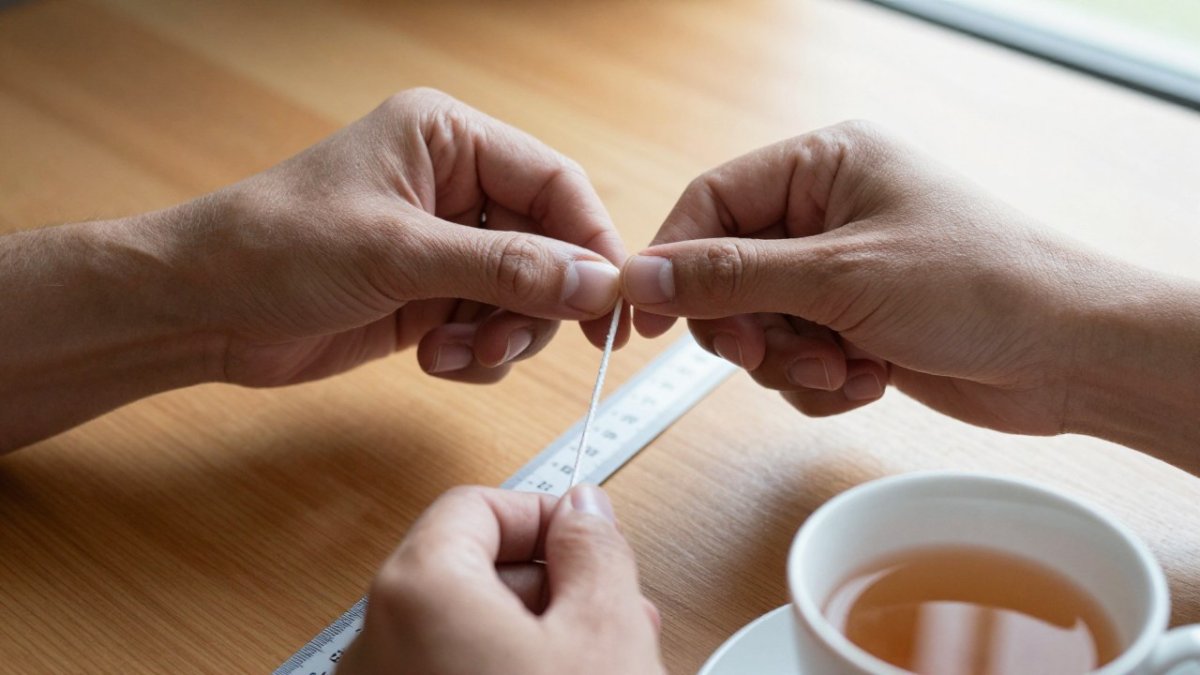
Step-by-Step: The String Method
- Wrap the string or paper strip around the base of the finger.
- Keep it snug but not tight. It should not press into the skin.
- Mark the point where the string overlaps itself.
- Lay the string flat against a ruler.
- Read the length in millimetres. This is your circumference.
- Repeat twice more and average the results.
A common mistake is pulling the string too tight. That gives you a band that will not slide over the knuckle.
Reading the Result in Millimetres
Your circumference in millimetres is the number you convert. For example, a circumference of about 54 mm maps to a specific standard size on most charts.
Write the number down before you convert it. Do not round to the nearest half centimetre, because small differences change the fit.
Using a Ring Sizer Tool for a More Reliable Reading
A ring sizer tool gives a more accurate reading than string because it mimics the actual band. Most sizers fall into three types, and each behaves differently on the finger.
- Metal ring sizer set: a graduated set of solid rings, usually in half-size increments. You slide each one over the knuckle and keep the one that passes with slight resistance and sits snug at the base. This is the closest match to how a finished band will feel.
- Adjustable belt sizer: a plastic or metal band that tightens around the finger like a zip tie. It is quick, but the flat belt does not curve like a round band, so it can read half a size small on some fingers.
- Sizing mandrel: a tapered metal rod marked in sizes, used by jewellers. The ring or sizer is slid down the mandrel until it seats, and the size is read from the scale. This is the most consistent method because the taper matches the shape of a finger.
Slide the sizer over your finger and find the one that passes the knuckle with slight resistance. That is your size. If you are between two sizes, choose the larger one for a wider band.
When using a metal sizer set, test the fit the way you will wear the ring: push it on in the morning and again in the late afternoon.
Watch out: an adjustable belt sizer pulled tight enough to stay on will read smaller than the true size, so loosen it until it just sits without pressing into the skin before you read the scale.
If you are testing against a ring you already own, place it on the mandrel or compare its inner diameter to the sizer set rather than relying on the number stamped inside the band, which can vary between manufacturers.
The main sizer types behave differently on the finger, so it helps to know what each one is best at.
| Option | Best for | Key difference |
|---|---|---|
| Metal ring sizer set | Closest match to a finished band | Graduated solid rings, usually in half-size increments |
| Adjustable belt sizer | Quick checks | Flat belt can read half a size small |
| Sizing mandrel | Most consistent method | Tapered rod matches the shape of a finger |
Reading a Ring Size Chart and Converting International Sizing
A ring size chart converts your millimetre measurement into a standard size. The tricky part is that sizing systems differ across regions, so the same finger can carry different numbers on different charts.
Use these steps:
- Find your circumference in millimetres.
- Locate that number on the chart's inner diameter or circumference column.
- Read across to your local size.
- Check the international columns if you are ordering from overseas.
Once you know your size, you can browse women wedding band options that suit your measurement and style.
Watch out: some charts list diameter, not circumference. Diameter is the width across the inside of the ring, so mixing the two up gives a size that is far too small. Circumference is roughly 3.14 times the diameter, so a 17 mm diameter is about 53.4 mm around. If a chart gives you one number and you measured the other, convert before you compare.
The Australian Letter System and Half Sizes
Australian ring sizes are usually written as letters, running from A (smallest) upward through the alphabet, with half sizes in between (for example, L, L½, M, M½). Ring sizes vary between jewellers, so always use the chart supplied by the retailer you are buying from.
Half sizes matter more than most people expect. A half size is roughly 1 mm of circumference, which is enough to change a band from comfortable to tight. If your measurement falls between two letter sizes, do not round to the nearest whole size; note the half size and check whether the retailer offers it.
Converting Between Systems
If you are ordering from an overseas retailer, you will often see US numeric sizes, UK/Australian letter sizes, and European sizes expressed as the inner circumference in millimetres.
Write your circumference down in millimetres and keep it alongside the converted size. If a chart and a sizer disagree, trust the physical sizer over the chart, because the chart is only a conversion table and the sizer is the actual fit.
How Tight Should a Ring Be on Your Finger?
A wedding band should feel snug but comfortable. It should slide on with slight resistance over the knuckle and sit firmly at the base without pinching.
You should be able to twist it gently, but it should not spin freely or slide off when your hand is cold. If the skin bulges around the band, it is too tight.
Band style also affects how a ring feels. If you are deciding between shapes, our contour wedding band vs straight band guide explains how each sits against an engagement ring.
Knuckle Size, Band Width and Seasonal Swelling: What DIY Guides Miss
Most guides stop at the string method. That is where they fail you.
Three factors change your true size, and none of them show up in a basic chart.
Knuckle size vs base size. Your knuckle is often wider than the base of your finger. A band must clear the knuckle but sit snug at the base. Measure both points and choose a size that passes the knuckle comfortably.
Band width. A wide band feels tighter than a narrow one at the same size. If you are choosing a broader style, size up slightly. Our men wedding band range shows how width changes the fit.
Seasonal swelling. Fingers swell in heat and shrink in cold. Measure in the middle of the day, at normal room temperature, and avoid measuring after exercise or a hot shower.
Troubleshooting Common DIY Measurement Errors
- String stretched during wrapping: use paper instead, which holds its length
- Measured a different finger: always measure the exact finger the band is for
- Read the ruler from the wrong end: check the zero mark before measuring
- Measured a cold hand: warm up first, then measure
- Chose a size between two options: go larger for wide bands
Book a Consultation for a Professional Sizing
A professional sizing removes the doubt entirely. Our diamond specialists will guide you through selecting the right size and design for your ring.
If you would like expert guidance on your measurement and design, you can book a consultation. Our VIP complimentary design consultation includes a glass of bubbles on arrival in our luxury showroom in Bulimba.

Getting the measurement right is the difference between a band you forget you are wearing and one you notice every day. If you would rather have an expert confirm your size, Starfire Jewellery offers personalised sizing consultations, access to ethically sourced diamonds, and custom design guidance from specialists with decades of experience. Get started with Starfire Jewellery and order a wedding band that fits from the first wear.
Frequently Asked Questions
How do I measure my ring finger for a wedding band at home?
Wrap a strip of paper or non-stretchy string around the base of your finger, mark where the ends meet, then lay it flat against a ruler and read the length in millimetres. That circumference maps to a size on a ring size chart. Measure at the end of the day when your finger is at its largest, and repeat the process two or three times. If your knuckle is wider than the base, measure both and choose a size that clears the knuckle comfortably.
Can I measure ring size with string or paper, and is it accurate?
Yes, you can measure ring size with string or a paper strip, and it is accurate enough for a first estimate if you work carefully. The main risk is stretch: string and paper both give slightly if pulled tight, which under-reports your circumference. Use non-stretchy string, keep the tension snug but not tight, and mark the overlap precisely. Compare your result against a printed ring size chart, and confirm with a ring sizer tool before committing to a final band.
How tight should a wedding band be, and should it match my engagement ring size?
A wedding band should slide over the knuckle with slight resistance and sit snug at the base without pinching or leaving deep marks. You should be able to twist it gently but not spin it freely. A wide band feels tighter than a narrow one at the same size, so you may need to go up a quarter or half size. Your wedding band does not have to match your engagement ring size, especially if the band is wider or you plan to wear them stacked.
Does finger size change with temperature or time of day?
It does. Fingers swell slightly in warm weather and after exercise, and they are at their smallest in the early morning and in cold conditions. Measure in the afternoon or evening at room temperature for the most representative reading. If you are between sizes, choose the larger one.

Related post

How Many Ring Design Revisions Are Included in a Custom Ring

7 Steps to Choosing an Ethically Sourced Anniversary Necklace

7 Steps to Design Your Own Engagement Ring Online

What Diamond Carat Size Looks Best on Your Hand

Best Ethical Engagement Rings Australia: A Practical Buying Guide
